How Memodyne Works
The three pathways the formula is built around, what the underlying science actually establishes, and where the honest limits are.
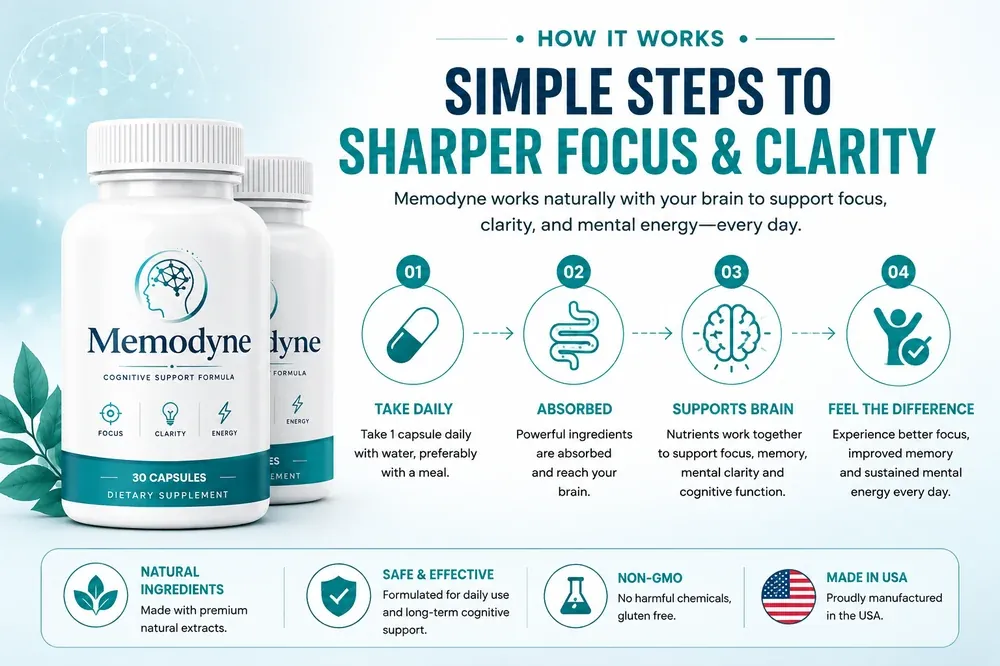
The Memodyne Daily Routine, Illustrated
The manufacturer's own summary of the routine and the marks the product carries, reproduced so you can read it directly rather than through anyone's paraphrase.
Why Memodyne Targets Circulation Rather Than Neurotransmitters
Most cognitive supplements work on the signalling side of brain function — acetylcholine, dopamine, the messages neurons send each other. Memodyne takes a different angle, and understanding it makes the rest of the formula make sense.
The brain is metabolically expensive. It accounts for roughly two percent of body weight and consumes around twenty percent of the body's oxygen and glucose at rest. It stores almost no fuel of its own, which means it depends on continuous delivery through a dense network of small blood vessels.
So there is a supply side to brain function as well as a signalling side: how much blood reaches tissue, and how efficiently cells convert what arrives into usable energy. That supply side is what this formula addresses.
It is a coherent premise. It is also worth being clear that a coherent premise is not the same as demonstrated effect in a finished product, which is what the rest of this page works through.
The Five Memodyne Pathways
What each stage means, with the evidence characterised honestly.
Memodyne circulation support
Four of the six ingredients feed the nitric oxide pathway. The body converts arginine into nitric oxide via an enzyme called nitric oxide synthase; citrulline converts into arginine first, which in practice raises arginine levels more reliably than taking arginine directly, because much oral arginine is broken down in the gut and liver before it reaches circulation.
Nitric oxide signals the smooth muscle in blood vessel walls to relax, allowing vessels to widen. This mechanism is established physiology and was recognised with a Nobel Prize in 1998.
Memodyne sustained circulation support
The formula uses two forms of each amino acid rather than one. L-arginine AKG binds arginine to alpha-ketoglutarate, and L-citrulline malate pairs citrulline with malate. Both partners are intermediates in the Krebs cycle, the central engine of cellular energy production.
The stated intent is supporting absorption and extending the effect through the day. Whether four sources outperform one at a higher amount is a fair question that cannot be answered from outside, because the amounts are not published.
Memodyne cellular energy support
Niacin is the precursor for NAD+, a coenzyme involved in essentially every reaction that converts food into cellular energy. NAD+ levels are an active area of ageing research, which is part of why niacin appears in formulas like this one.
Vitamin B3 carries a formally recognised role in normal energy-yielding metabolism. This is the one claim in the formula resting on established nutrition science rather than mechanistic inference — while noting the claim describes adequate intake rather than surplus.
Memodyne antioxidant support
Beta-alanine is the rate-limiting building block the body uses to form carnosine, a dipeptide of beta-alanine and histidine. Carnosine has documented buffering properties and has been studied as an antioxidant and metal-chelating compound.
The honest caveat: the great majority of carnosine research concerns skeletal muscle and exercise performance rather than brain tissue. Carnosine is present in the brain and the reasoning is plausible, but the trail is less direct than for the other pillars.
The Memodyne non-stimulant approach
Nothing here produces an acute effect. That is deliberate design rather than a shortfall — no tolerance, no crash, and nothing active at bedtime undermining the sleep that clear thinking depends on.
It also means there is no feedback loop. You will not feel it working, which makes the 60-day guarantee window the sensible unit of evaluation rather than the first week.
The Honest Limits of the Memodyne Approach
Three things are worth stating plainly, because they are what a careful buyer would want to know and they rarely appear on pages like this.
The pathway is established; the application is less so. Nitric oxide biology is textbook material. Whether supplementing precursors meaningfully changes cerebral blood flow in a healthy adult is a considerably more open question, and most human research on these amino acids has been conducted in exercise contexts rather than cognitive ones.
The amounts are unknown. Research doses of citrulline and beta-alanine in published studies are often substantial — several grams daily in some protocols. A single daily capsule containing six ingredients has finite physical space. Without published figures, nobody outside the company can assess how the formula compares to studied intakes.
Circulation responds strongly to things that are free. Aerobic exercise is the single most effective intervention for vascular health and cerebral blood flow, with an evidence base far exceeding any supplement. Hydration, blood pressure management and not smoking all matter more. A capsule sits alongside these, not in place of them.
How to read the research on this Memodyne page
The research described here examined individual ingredients, usually on their own, at doses set by the researchers. It provides scientific context for why an ingredient is included in a formula.
It does not demonstrate that the finished Memodyne product produces the same outcomes. No clinical trial of this finished formula has been published, so nothing on this website is product-level clinical evidence.
Memodyne does not disclose per-ingredient amounts
All six ingredients are named, which is more than many products in this category offer. What is not published is how much of each one a capsule contains.
That matters, because an ingredient's effect depends on its amount, and without figures nothing here can be compared to the doses used in published research. No milligram figures appear anywhere on this website — inventing them would be worse than leaving them out. If you see a page quoting precise amounts for this product, that information is not coming from the manufacturer.
Taking Memodyne Day to Day
The routine, and the details that decide whether it survives its first busy week.
Take Memodyne in the morning, before food
The brand's stated instruction, and there is sensible reasoning behind it. Amino acids are generally better absorbed without competing dietary protein, and taking it before breakfast anchors the habit to something you already do daily.
Drink the full glass of water
Not incidental advice. Hydration affects blood volume and therefore circulation directly, which is the very thing this formula is positioned around. Mild dehydration also affects concentration independently, so the glass of water may be doing more work than people assume.
Pair Memodyne with the habits that actually move circulation
Regular aerobic activity, adequate hydration, balanced nutrition and blood pressure management all influence vascular health considerably more than any capsule. The supplement is designed to complement these rather than substitute for them.
Track your Memodyne guarantee window
Note your purchase date. The 60-day window runs from purchase rather than delivery, and the brand suggests at least 30 days of use before judging. A reminder at around day 50 keeps the decision yours.
Speak to your doctor first if any of these apply
This formula is built around nitric oxide precursor amino acids, which relate to blood vessel dilation. That makes a medication check genuinely important rather than a formality. Show the label to your doctor before your first capsule if you:
- Are pregnant or nursing
- Are under 18
- Take blood pressure medication
- Take blood thinners
- Take nitrate medication
- Take PDE5 inhibitors
- Take any other vasodilator
Memodyne is a dietary supplement for healthy adults. It is not a substitute for prescribed medication or for treatment of any diagnosed neurological or cardiovascular condition.
What Memodyne Costs to Take Daily
One capsule a day means a bottle covers thirty days, so the per-day figure is the only number that stays comparable across packages running for different lengths of time. It is also the number the compare-at pricing draws attention away from.
Six bottles works out at roughly $1.63 a day, three at about $2.30, and two at around $2.63 before the shipping charged on that tier. Whether that is good value is your judgement — but it is worth making against the daily figure rather than the discount.

The Memodyne 60-Day Money-Back Guarantee
Memodyne is backed by a 60-day money-back guarantee running from the date of purchase. The brand states that after at least 30 days of use, if you are not completely satisfied, you contact customer support before the 60-day window closes to discuss your options.
Purchase date. Note it down — the window runs from here, not from delivery.
The brand's suggested trial period. Circulation support is framed as gradual.
Guarantee closes. Contact support before this date, not after.
Two practical points. The window starts at purchase rather than delivery, so shipping time comes out of your 60 days. And the six-bottle package holds 180 days of product, so the guarantee closes with four bottles still unopened — set a reminder for around day 50.
Full refund terms are set by the seller. Read the official policy at checkout before ordering.
Start Your Memodyne Daily Routine
One capsule each morning with a full glass of water, taken alongside the balanced nutrition, hydration and regular activity that support circulation far more than any capsule does on its own. Six named ingredients, no artificial stimulants, and a 60-day money-back guarantee on every order.
From $49 per bottle · Non-stimulant · Free US shipping on 3 and 6 bottles · 5 bonus guides included